Showing posts with label biocontainment unit. Show all posts

Sunday, December 30, 2018

Why is Omaha the go-to place to hospitalize everyone exposed to the deadly Ebola virus these days?

The Ebola virus is back in town, and Omahans are welcoming it with open arms
By now, it's becoming very clear to anyone who reads the news that Omaha, Nebraska is the go-to place where U.S. government health care officials at the National Institutes of Health (NIH) and National Institute of Allergy and Infectious Disease (NIAID) prefer to send anyone suspected of either having or being exposed to the world's most deadly infectious diseases around the world, such as the deadly Ebola virus, when infected Americans come back to the U.S. for possible monitoring and/or treatment.

Just this Saturday, an unnamed U.S. health care worker, who may have been exposed to the deadly Ebola virus while treating patients in the Democratic Republic of Congo (DRC), arrived back in the U.S. and was put in immediate quarantine at Nebraska Medicine in Omaha, NE.

Monday, November 21, 2016

Officials designate Omaha, NE as possible flashpoint for the next impending zombie apocalypse

Government officials have designated Omaha as a dumping ground for taking people infected with BSL-4 agents
An emergency medical drill took place on Friday, designating the City of Omaha as one of only a handful of cities across the nation willing to accept multiple patients infected with the world's most deadly contagious infectious diseases.

Nebraska Medicine's willingness to take in more than one patient at a time infected
with a BSL-4 agent is taking a big risk of losing containment of the contagion
It sounds like a science fiction fantasy scenario of the beginning of the next zombie apocalypse as seen on TV shows like The Walking Dead, but as one of only a handful of bio-safety level 4 (BSL-4) containment centers around the world willing to take in more than one patient infected with the world's most deadly infectious diseases at a time, Omaha may be a likely potential flash point or hot zone for the spread of the next global pandemic of epic proportions.

Only two years ago, Omaha's Nebraska Medicine was on the front lines taking in and treating patients from West Africa infected with the deadly Ebola virus during the worst outbreak of the virus in recorded history. Three patients diagnosed with the virus were brought into Omaha, and two survived. Luckily for us, the virus didn't break containment.

Tuesday, March 31, 2015

5 U.S. aid workers monitored and quarantined for Ebola in Omaha released

The Ebola outbreak continues to ravage West Africa 
Five American aid workers being observed and monitored at the Biocontainment Unit at the University of Nebraska Medical Center (UNMC) in Omaha, Nebraska for exposure to the deadly Ebola virus have completed their quarantine periods free from symptoms of the deadly virus and have been released.

The biocontainment Unit at UNMC
Nebraska Medical Center spokesman Taylor Wilson said Tuesday that four of the individuals who were brought to Omaha earlier this month for monitoring have already left the area. 

The fifth, who developed a heart problem Saturday and required CPR, has now been discharged from the hospital and will soon also leave Omaha.

The U.S. health care missionary workers were exposed to Ebola in Sierra Leone in West Africa when one of their colleagues became ill with the deadly virus. 

They were staying on the Nebraska Medical Center's campus while in quarantine. Ebola has a 21-day incubation period before showing signs and symptoms of an infection.

Monday, January 5, 2015

Patient exposed to the Ebola virus hospitalized in Omaha

Another American exposed to Ebola is brought to UNMC for quarantine and treatment in Omaha, NE 
An American health worker exposed to the Ebola virus while working in Sierra Leone, Africa arrived in Omaha, NE Sunday and is now being monitored at the University of Nebraska Medical Center (UNMC) in its level-four biohazard containment unit on campus.

Safety measures taken 'out of an abundance of caution' in transporting patients
exposed to the Ebola virus in West Africa at Epply Airfield in Omaha
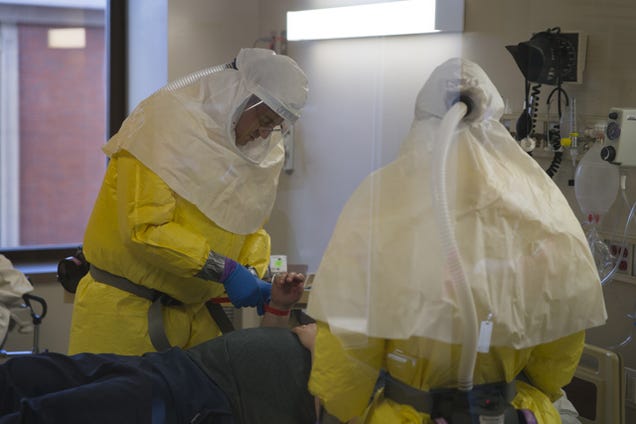
Paramedics were taking no chances in handling the patient so they were wearing full-body protective gear akin to a NASA space suit as they took an Ebola patient, who has not been identified, by ambulance from a plane that arrived at Eppley Airfield around 1:45 p.m. to the hospital, which has a specialized biocontainment unit.

"I can't comment on if the patient does or doesn't have any kind of symptoms at this point, but I can say the crew inside the biocontainment unit, the crew that received the patient at the airport, is treating this patient as if he or she does have the virus, just out of an abundance of caution," said UNMC spokesman Taylor Wilson.

“This patient has been exposed to the virus, but is not ill and is not contagious,” said Dr. Phil Smith, medical director of the level-4 biocontainment unit. “However, we will be taking all appropriate precautions. This patient will be under observation in the same room used for treatment of the first three patients and will be carefully monitored to see if Ebola disease develops.”

Tuesday, November 18, 2014

UNMC's third Ebola patient, Dr. Martin Salia, dies in Omaha

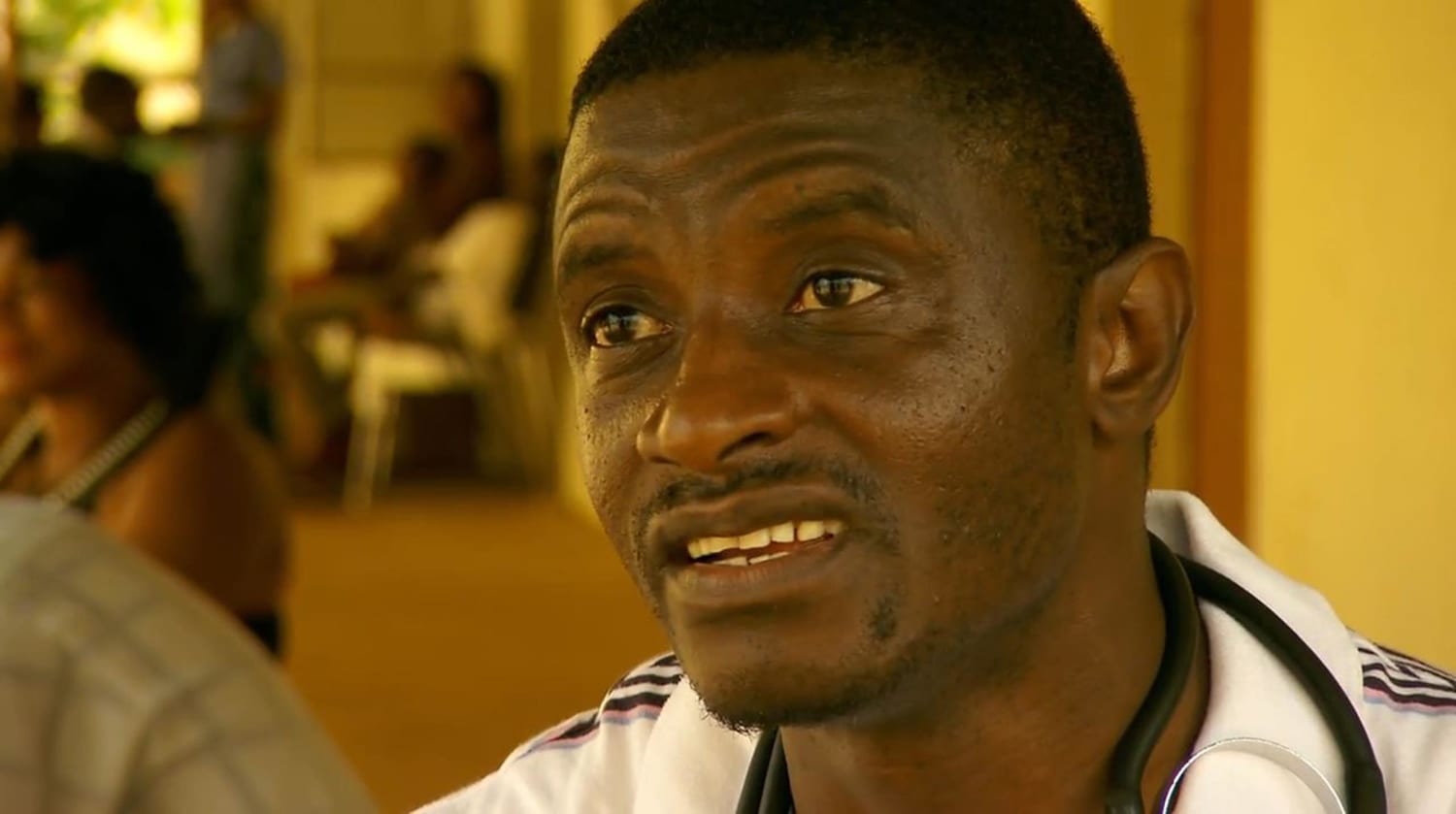
Dr. Martin Salia of Sierra Leone succumbed to the Ebola virus on Monday morning 
A West African surgeon, who contracted the deadly Ebola virus in his native Sierra Leone and was flown to Omaha for treatment, received aggressive treatment at University of Nebraska Medical Center (UNMC) over the weekend but died Monday morning.

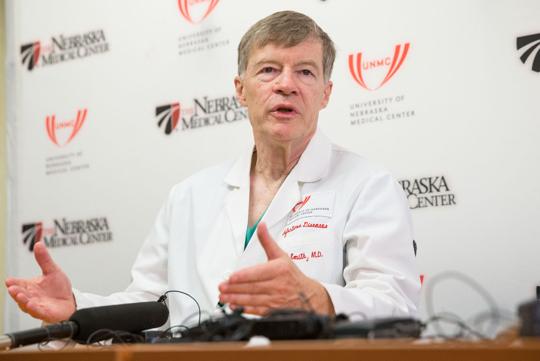
The medical director of UNMC's Biocontainment Unit did not have good news
to report on Monday when Dr. Martin Salia succumbed to Ebola virus
Dr. Martin Salia's death is a reminder of just how deadly the Ebola virus is and how important it is to receive treatment as soon as possible, said Dr. Jeff Gold, chancellor of the UNMC in Omaha.

"In the very advanced stages, even the modern techniques we have at our disposal are not enough to help these patients once they reach a critical threshold," Gold said at a news conference announcing the medical center’s first fatality from Ebola.

Salia, 44, was diagnosed with the virus Nov. 6, 2014. By the time he was flown to Omaha for treatment on Saturday, he was in already in an advanced stages of shock in critical condition with no kidney function and in severe respiratory distress.


He was placed on dialysis and intubated on a ventilator, and was given several supportive medications to support his failing organ systems, the hospital said in a statement. 

Thursday, October 23, 2014

The second patient treated for Ebola at the UNMC in Omaha has been released after testing negative for the virus

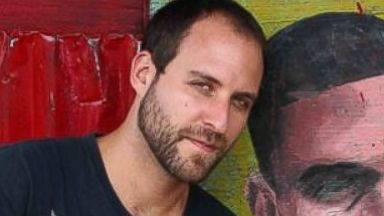
NBC News videographer Ashoka Mukpo on assignment
The second patient treated for an Ebola at the University of Nebraska Medical Center's Biocontainment Unit in Omaha has been released after testing negative for the virus in two consecutive blood tests over 24 hours.

NBC News cameraman and Ebola survivor Ashoka Mukpo ready to leave
UNMC to go home after a two-week ordeal recovering from the Ebola virus
Ashoka Mukpo was working as a free-lance videographer for NBC News in Liberia when he contracted the deadly Ebola virus earlier this month. After his diagnosis, Mukpo was transported via jet to UNMC's Biocontainment Unit for quarantine and treatment. 

He was released Wednesday afternoon after about two weeks of treatment at the hospital’s Level-4 Biocontainment Unit.

Mukpo bounced back quicker and was in the hospital five fewer days than Dr. Richard Sacra, the first U.S. Ebola patient to be treated at UNMC.

Mukpo received the same basic treatment as Sacra, but was able to take an experimental drug against Ebola in pill form, where as Sacra needed an IV. There still is no cure to the deadly Ebola virus, which can have a mortality rate of up to 90 percent in those infected who are left untreated.

At a news conference, Dr. Phil Smith, medical director of UNMC's Biocontainment Unit, who treated both men’s treatment, said with each case treated at UNMC, the medical community gains valuable insight and information about how to deal with the deadly Ebola virus.

Friday, September 26, 2014

Dr. Rick Sacra back home after leaving Nebraska Medical Center

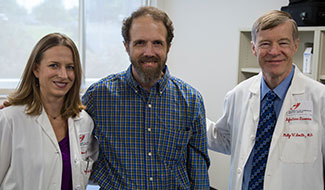
Dr. Angela Hewitt, Dr. Rick Sacra, and Dr. Phil Smith at the UNMC Biocontainment Unit
The first patient who has been treated at the University of Nebraska Medical Center (UNMC) for an Ebola viral infection, Dr. Rick Sacra, has been let out his isolation room in the Biocontainment Unit after three weeks, and has headed home. The U.S. Centers for Disease Control and Prevention (CDC) has confirmed that two consecutive separate blood samples taken from Dr. Sacra 24 hours apart show the virus is no longer in his bloodstream.

Dr. Rick Sacra out of trouble and ready to go home after contracting the deadly
Ebola Virus in West Africa
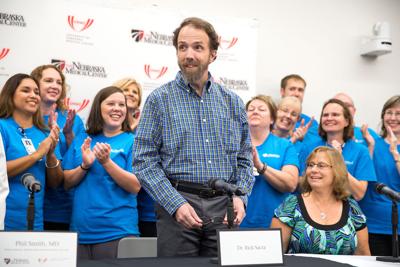
“It was very gratifying for the entire team that treated Dr. Sacra to see him walk out the doors healthy again,” said Dr. Phil W. Smith, medical director of the Biocontainment Unit and professor of infectious disease and epidemiology at UNMC. “When he arrived three weeks ago, he was extremely ill with a virus the world doesn’t have a lot of experience treating. To know that we were able to play a role in helping his body fight off the virus so he could be reunited with his family and continue doing the work he’s so passionate about makes the years we’ve spent training and preparing for something like this more than worth it.”

"I am so grateful,” said Dr. Sacra. “Just so incredibly grateful to have gotten through this illness! Many were praying for me, even people I did not know personally. During the time I was here, there was a growing confidence that God was answering those prayers, and that I was steadily improving. Thanks to God and to the team here at The Nebraska Medical Center!"


“It was very gratifying for the entire team that treated Dr. Sacra to see him walk out the doors healthy again,” said Phil Smith, M.D., medical director of the Biocontainment Unit at The Nebraska Medical Center.